There’s a piece of music that lives in my head uninvited. The Superman theme. John Williams, brass section, the whole thing. It shows up when I’m feeling something I can’t quite name — a kind of readiness, maybe. A sense of capability. For most of my life I’ve been suspicious of it. “That theme makes you think you’re invulnerable”, I told myself, “and that’s dangerous.” So I’d push it back down whenever it surfaced, the way you’d put a lid on something that might boil over.
It was playing in a hospital hallway yesterday, while I stood outside an ICU room and watched a man die.
I want to write about presence. Not the word we use casually —* I was present*, meaning “I showed up”, meaning “I was in the room”. I mean the other thing. The harder thing. The thing that’s almost impossible to perform, because the moment you try to perform it, it’s gone.
Connie Ray — I’ll call him that — was a man I knew. He coded in the afternoon, after the doctors had said middle of the road, after they’d talked about moving him to stepdown. There were dozens of hospital workers in the hallway when it happened. Every one of them there to help if needed, ready but not pushing, doing their job without needing to be seen doing it. I watched that and thought: this is what presence actually looks like. Organized. Quiet. Competent. Pointed entirely outward.
That last part is the key: pointed. entirely. outward.
He didn’t make it. Sometimes the machinery of care isn’t enough.
What followed was a different kind of education.
I don’t want to be specific, because specificity here would be unkind, and this isn’t about unkindness. What I’ll say is that grief, in a community, has a way of drawing out a particular human impulse — the need to be “the one”. The most important person in the room. The irreplaceable presence. The rock. The hero.
I watched people jockey for position outside a widow’s car door. I watched faces get grabbed and held before the woman could get her bearings. I watched the room get loud — louder than the occasion asked for — while the actual grief sat somewhere in the middle of it, waiting for a little air.
I watched someone receive a phone call from a person who hadn’t spoken to her in a long time but who, on the very morning the news went out, had felt moved to call. God had put her on their heart. What a coincidence.
I know this impulse. I want to be honest about that. I’ve felt it myself, the pull toward the center of someone else’s crisis, the need to be needed, the performance of indispensability. The Ghost, I call it in my own internal vocabulary — the voice that confuses being seen helping with actually helping. It’s in me. It’s probably in most of us, some percentage of the time.
The question is whether you catch it before it gets to the door.
There’s a proverb, Persian I think, about the fool at the feast. The wise man recognizes the room and withdraws. Not in defeat. Not in judgment. Just — “this is not what I came for, and I will not contend for it.”
I left at nine o’clock. No wave, no announcement. Just gone.
My wife had been there for days — sitting with Gay, sleeping in the recliner in her bedroom when needed, doing the quiet unglamorous work of being genuinely available. That’s not the same thing as what I watched happen at the car door. It doesn’t photograph as well. It doesn’t make a good story at the funeral. But Gay knew the difference. In the middle of everything, she made that clear.
Presence doesn’t announce itself. That’s almost the definition of it.
I’ve spent the last several years learning — slowly, sometimes painfully — the difference between doing the thing and performing the thing. I left a job rather than keep performing a version of competence I didn’t believe in. I’ve been building something real since then, at the cost of a lot of security I used to think I needed.
What I’m learning is that presence is a practice, not a state. You don’t arrive at it. You just keep choosing it, over and over, against the pull of the alternative.
The Superman theme was playing in the hallway because something in me knew that staying — quietly, without announcement, without needing to be the hero — was the right thing. Not heroic. Just right. There’s a version of strength that has nothing to do with invulnerability. It has to do with being available when it counts, and leaving when you’re not needed, and never confusing the two.
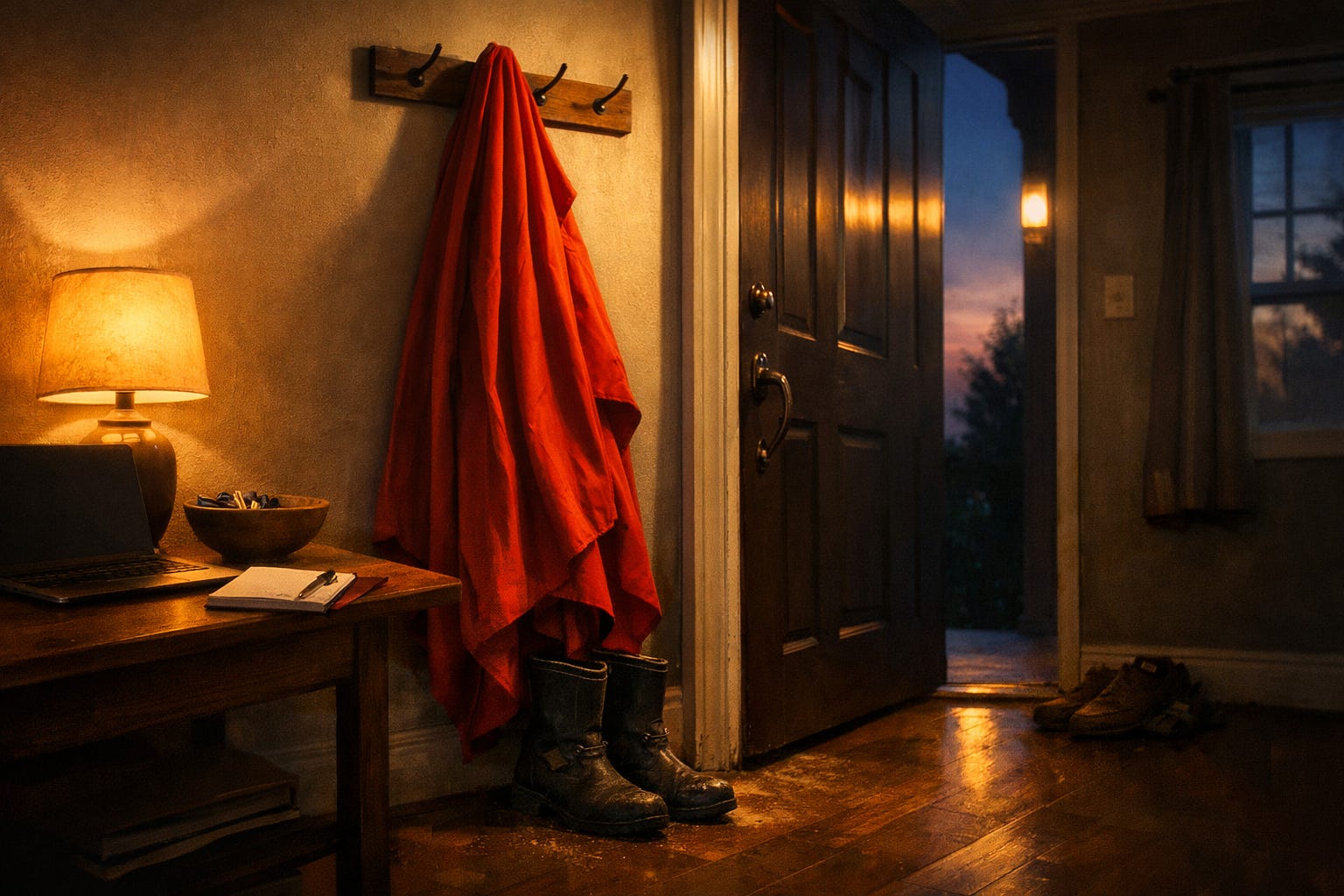
The cape has to hang somewhere. That somewhere is not someone else’s grief.
I’m still working out what I believe about all of this. But I think genuine presence — the kind that actually helps — is always quiet, always pointed outward, and never needs the room to know it’s there.