We see the issue in living color, every time we turn on the news now. But it isn’t just the politicians and billionaires. The counterculture movement is equally guilty.
You know the structure of these movements well. They have the right enemies, the correct politics, the impeccable critique of whoever holds power, or horrible criticism of those who don’t hold power right now, but might later.
And here’s the confusing part: Everything it says about the problem sounds true, but everything it proposes as a solution somehow never quite reaches the person who actually needs it.
This is where you’re probably expecting me to launch a diatribe with newsworthy names. Not this time. This is about what open source is becoming.
I’ve been inside those rooms, where the conviction is real and the values aren’t wrong. But somewhere between the manifesto and the morning, the work stopped being for the people who need it, and started being against some other power-monger.
Here’s the distinction worth sitting with: integrity of worldview versus effectiveness at serving humans. They feel like the same thing when you’re in the middle of it, but they aren’t.
What open source promised
The open source movement has noble ideals: software is knowledge, knowledge wants to be free, and licensing fees are a kind of theft from the commons. That argument has force: proprietary software can be predatory. But open source made some ambiguous promises.
Open source said you won’t have to pay for the right to use your own computer. But in translation, ordinary humans made the assumption that open source works as well as proprietary software. What open source frequently delivers? This is free, and if you learn to compile from source, configure dependencies, haunt the right forums, and don’t mind things occasionally breaking when you update — it mostly works.
At the end of the day, the spoken and heard promises don’t match up. And for the vast majority of humans, that trade-off doesn’t work.
What end users actually need
Non-programmer humans actually want their technology to work, now and the next time, and to work with all the other things you offer. And when something goes wrong, to have a fix path that doesn’t require advanced knowledge and Stack Overflow.
That’s it. That’s the whole list.
The open source world sort of tiptoes around this, the way salesman duck questions. The person who just wants their laptop to find their printer “just doesn’t appreciate the freedom.” Counterculture framing — you just don’t understand what we’re giving you — doesn’t help.
End users have come to see that free-as-in-freedom doesn’t pay for the hours they lost fighting their wifi drivers; that the ideological purity of the license doesn’t help them when the software eats their file; that a product which requires a significant learning curve is taking them on continual side-quests. Users don’t have time to be the integration layer.
The irony of what people actually pay for
Here’s what the open source movement missed about human psychology: people don’t resist paying for things that work. They resist paying for things that don’t.
The resentment toward Microsoft licensing fees in the 1990s and 2000s wasn’t purely about the money. It was about paying significant money for bloated software that crashed and held your data hostage to its own formats, while the company treated you as a captive rather than a customer. The price and the experience were both bad.
Open source identified the price as the problem, but the users were actually reacting more to the experience.
Apple understood this. Not because Apple is morally superior — it isn’t, and its own vendor lock-in is real and deliberate — but because Apple asked a different question. Not how do we free people from licensing fees, but how do we make something people are glad they paid for. You pick up an iPhone, put on a watch, or open a laptop, and your data follows you. The system handles the plumbing so you don’t have to.
And here’s the thing: people pay for that. Willingly. Repeatedly. Not because they’ve been captured (though they have been), but because the experience of things just working together is genuinely valuable. Worth ongoing subscriptions for things that extend the ecosystem in useful ways.
The open source movement wanted to liberate people from the tyranny of the license fee. Apple made the license fee feel like membership in a club that respects your time.
The question behind the rebellion
I’m not arguing that proprietary software won on merit, or that open source was wrong to exist, or that the critique of corporate control of software infrastructure was misguided. The critique was correct. The enemies were real.
But ideological purity is not the same as useful product. And a movement that spends more energy on righteousness than on usability has confused its integrity for mission. If you’re constantly bragging about how smart you are, well….
The question I now ask about any work I do, any project I take on, any act of creative or professional creation: Am I building something a human can pick up and use, or am I just making sure everyone knows whose side I’m on?
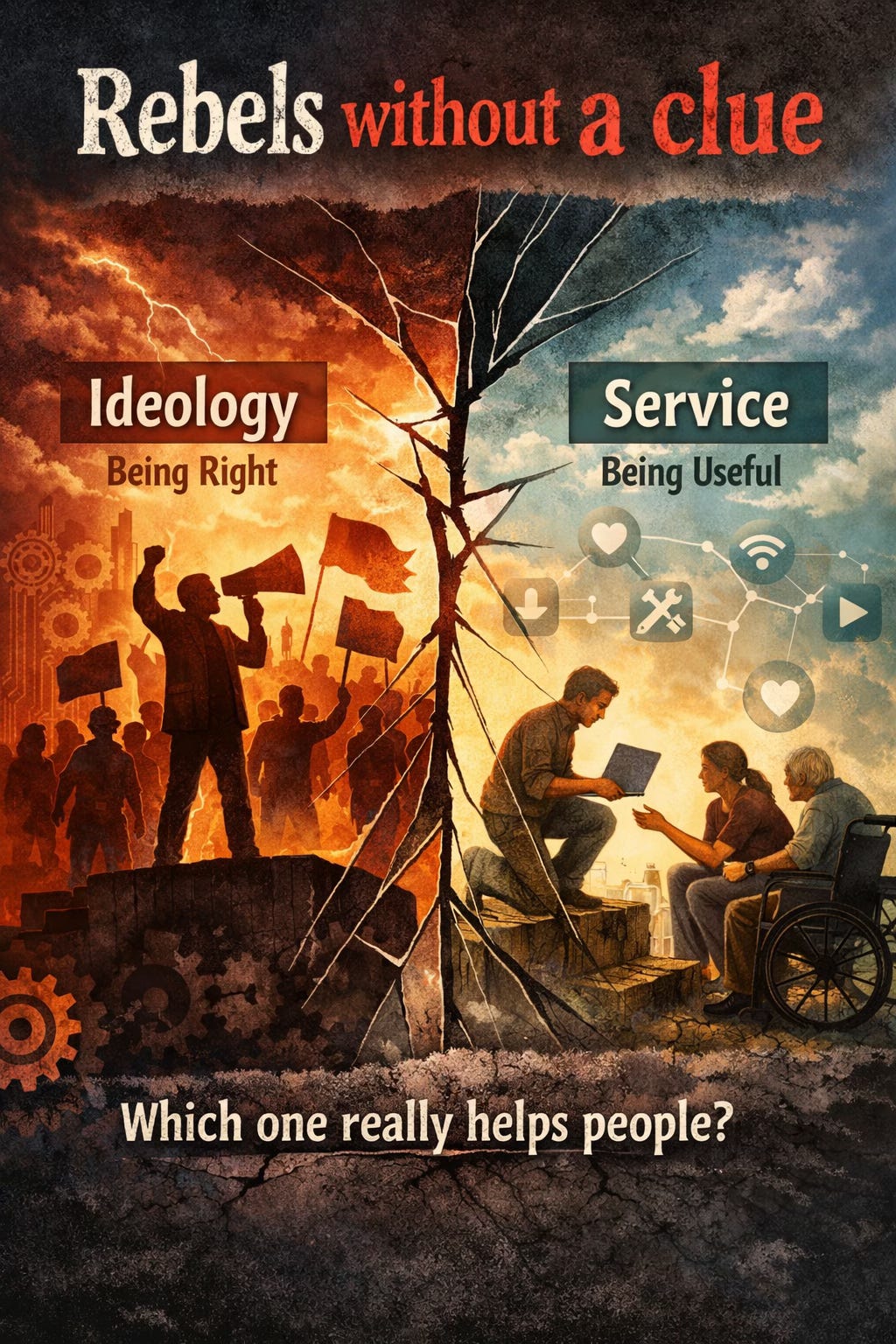
Real service to real humans is much harder than convincing everybody that you’re a cult of genius. It requires you to care more about whether things work than about whether they follow your One True Way. It requires you to meet people where they are rather than where you think they should be.
Most lessons worth keeping can only be learned in the marketplace, among regular people. Open source is falling out of touch. Pity.